clamcleat.com uses cookies to ensure we give you the best experience on our website. By navigating our site, you agree to allow us to use cookies, in accordance with our Privacy Policy
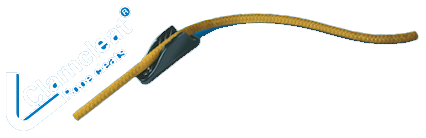


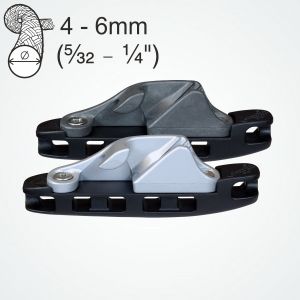
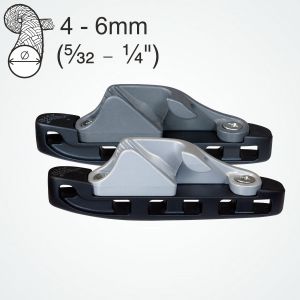
CL828-77 Aero cleat with CL277 Side-Entry Micros
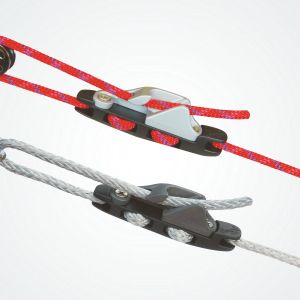
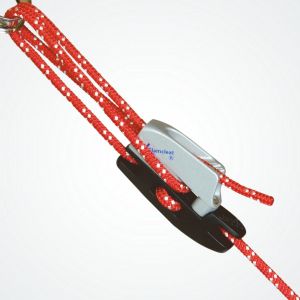
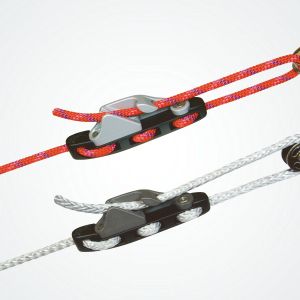
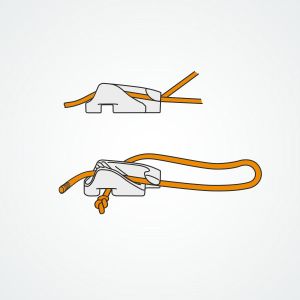
Rope hooks under fairlead in Side-entry version of smallest Aero cleat.
| Technical Details | Metric | Imperial | |
|---|---|---|---|
| Rope Diameter |  |
3 - 4mm | 1/8 - 5/32" |
| Material |  |
Aluminium & Nylon | Aluminium & Nylon |
| Hole Centres |  |
n/a | n/a |
| Length |  |
60mm | 2 3/8" |
| Width |  |
13mm | 1/2" |
| Height |  |
31mm | 1 1/8 |
| Bolt Size |  |
n/a | n/a |
| Screw Size |  |
n/a | N/A |
| Weight |  |
22gms | 0.8oz |
Availability:
In stock
SKU
Clamcleat-CL828-77
A side-entry version of the smallest Aero cleat. The Clamcleat® CL828-77 allows the rope to be hooked under the fairlead of the cleat, so you can quickly rig and de-rig. The position of the cleat on the rope can be adjusted by hand. No tools required. It is strong, compact and wear resistant. The CL828-77 can be rigged with a 2:1 ratio, or use the becket under the cleat for a 4:1 ratio. Use this Aero cleat where you want to quickly remove the rope. Ideal for sports netting, hammocks, canvas structures, tie-downs radio masts and aerials.
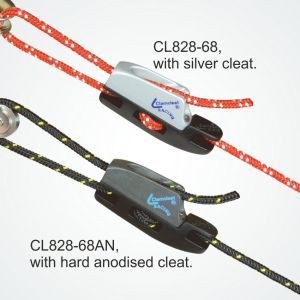
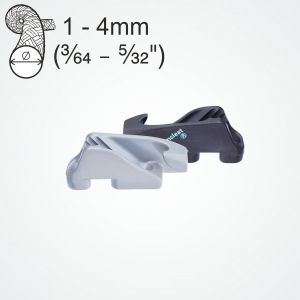
The CL828-77 Aero base is fitted with a silver CL277 aluminium side-entry Micros cleat.
The CL828-77AN is fitted with a hard anodised cleat.
If you want a closed fairlead, see CL828-68 for rigging with a 2:1 advantage and CL828-70 for rigging with a 4:1 advantage.
For larger 4-6mm ropes, look at the CL827-17, which also has a side entry fairlead.
The CL277 cleat only is also available.
To see all the cleats that can be rigged on ropes, click here.
Write Your Own Review

Q: What size of rope should I use on my CL828-77 cleat?
Ans: The size of rope used on the CL828-77 is from 3 to 4mm.
Q: What is an Aero cleat?
Ans: The Aero cleat allows the cleat to be positioned and adjusted along the rope easily and will accept a variety of cleats.
Q: What size of Aero cleats are available?
Ans: The CL828 range of Aero cleats use 3-4mm rope and the CL826, CL827 and CL828 range use 4-6mm rope.
Q: Why does Clamcleat® not publish safe working loads (SWL) or break loads for its cleats?
Ans: The quality, type and style of the rope or cord plays a major role in the performance of the cleat. Normally the better the quality of the rope the greater holding power, also some cleats are designed to slip once they exceed the desired holding load as a safety feature including securing fabrics such as sunshades or covers.
Q: Do you get a better performance with an Aluminum cleat?
Ans: Aluminum cleats do not improve the performance of the cleat, but they can achieve higher holding loads and they also might improve the lifespan of the cleat especially if the rope will be in contact with the teeth whilst the rope is being pulled through during adjustment.
Q: What different coating are there for the Aluminum cleats?
Ans: The standard coating for the cleat is a Stoving Aluminum silver enamel coating. For extra protection from corrosion and a high-tech appearance the cleats are also available in a dark grey Hard anodized finish. The part no in suffixed with “AN” to identify the hard anodized finish.
Q: How long should an Aluminum cleat last?
Ans: This really depends on the usage, the quality and age of the rope used etc. so is very difficult to gauge. The ultraviolet rays will discolor the cleats over time and in very sunny climates may affect the life of the cleat. In extreme climates the life expectancy should be 10 -15 years depending on usage and in more moderate climate 20 + years
Q: What type of rope or cord will give the best performance on my cleats?
Ans: In our experience a braided good quality rope gives you the best holding performance.
Q: Is there any maintenance required to a cleat to keep it performing well?
Ans: We would recommend flushing the with fresh water as often are you can.
Related Products