clamcleat.com uses cookies to ensure we give you the best experience on our website. By navigating our site, you agree to allow us to use cookies, in accordance with our Privacy Policy


PT422&23 Insulators for Mk1 Racing Junior cleats
Insulators for Mk1 racing Junior cleats
| Technical Details | Metric | Imperial | |
|---|---|---|---|
| Rope Diameter |  |
n/a | n/a |
| Material |  |
Nylon | Nylon |
| Hole Centres |  |
66mm | 2 5/8" |
| Length |  |
82mm | 3 1/4" |
| Width |  |
18mm | 11/16" |
| Height |  |
n/a | n/a |
| Bolt Size |  |
M5 | #10 |
| Screw Size |  |
4.8 | #10 |
| Weight |  |
0.91gms | 0.033oz |
Availability:
In stock
SKU
Clamcleat-PT422&23
Electrolytic de-composition has always been a problem since the introduction of composite masts and spars. This slowly damages the aluminium or carbon unless barrier paste, adhesive or a thin layer of plastic is used to keep the dissimilar compounds apart, which is always messy and time consuming.
This has been eliminated by the introduction of our insulators.
This PT422&23 fits all our Mk1 Racing Junior alloy cleats and look especially good with the hard anodised versions.
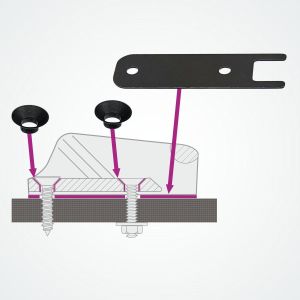
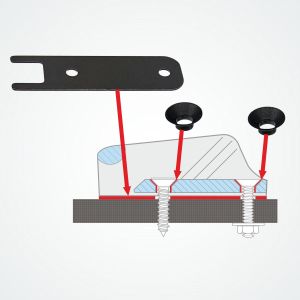
The countersink cones fit under the screw or bolt heads and the baseplate fis under the alloy cleat. This prevents galvanic corrosion of the alloy cleat by keeping it separate from the fixings and surface. Quick and easy to fit. The base will flex to fit any size of tube.
The PT424&25 is supplied as 1 base + 2 cones, attached to a sprue, to keep the parts together. To remove, just twist off by hand.
The cones are flexible enough to fit the slightly different size and shape of heads on wood screws, self-tapping screws and bolts. Do not overtighten as you will just distort the cone. As long as the cleat does not move, it will be fine.
The screw holes in the base are designed to be a tight fit for the screw/bolt, to make sure that these are insulated from the cleat.
Test results from our own agresive salt water testing, have proven these insulators really do eliminate corrosion problems.
The PT422 cones are avilable separately, for use with other fittings that use No10 (M5) fixings. Please contact us.
PT422&23 insulators are designed for use with these alloy cleats-
CL211 Mk1 Racing Junior.
CL217 Mk1 Side entry (Starboard) - You can trim the base to fit.
CL218 Mk1 Side entry (Port) - You can trim the base to fit.
CL230 Racing Junior Mk1 with roller (Using 2 bases enables just round holes to be drilled).
CL236 Roller Fairlead Mk1 Racing Junior.
CL704 Racing Junior Mk1 with Becket.
Two other sizes of insulators are:-
PT420&21 to suit all Mk2 Racing junior alloy cleats.
PT425&25 to suit all Micros Racing alloy cleats
Write Your Own Review

Q: What is the best way to fix an aluminum cleat into a carbon fiber spar?
Ans: You need to create a barrier between the aluminum cleat and the carbon fiber surface to stop electrolytic de-composition. Use PT420&21 for Mk2 cleats, PT422&23 for Mk1 cleats and PT424&25 for CL268, CL270, CL277 and CL278 which contains 2 CSK and 1 x base plate.
Q: Do you need to put a barrier between the Aluminum cleat and the stainless-steel fixing?
Ans: You need to add a CSK insulator between the Stainless-steel fixing and the cleat and a base insulator between the cleat and the spar. Use PT420&21 for Mk2 cleats, PT422&23 for Mk1 cleats and PT424&25 for CL268, CL270, CL277 and CL278 which contains 2 CSK and 1 x base plate.
Q: Do you get a better performance with an Aluminum cleat?
Ans: Aluminum cleats do not improve the performance of the cleat, but they can achieve higher holding loads and they also might improve the lifespan of the cleat especially if the rope will be in contact with the teeth whilst the rope is being pulled through during adjustment.
Q: What different coating are there for the Aluminum cleats?
Ans: The standard coating for the cleat is a Stoving Aluminum silver enamel coating. For extra protection from corrosion and a high-tech appearance the cleats are also available in a dark grey Hard anodized finish. The part no in suffixed with “AN” to identify the hard anodized finish.
Q: How long should an Aluminum cleat last?
Ans: This really depends on the usage, the quality and age of the rope used etc. so is very difficult to gauge. The ultraviolet rays will discolor the cleats over time and in very sunny climates may affect the life of the cleat. In extreme climates the life expectancy should be 10 -15 years depending on usage and in more moderate climate 20 + years.
Q: Can I fit my cleats using pop rivets?
Ans: Using pop rivets to fit your cleat is a tidy quick way of securing the cleat. Ensure the pop rivet is at 90 degrees to the cleat when fixing and with certain smaller cleats the head of the pop rivet gun will not sit onto the pop rivet when in place so you will require to add a spacer between the gun and the rivet.
Q: Is there any maintenance required to a cleat to keep it performing well?
Ans: We would recommend flushing the with fresh water as often are you can.
Related Products