For fixing alloy cleats permanently to aluminium surfaces and structures, welding cleats can be quicker and less expensive than drilling holes and using bolts. Clamcleats Limited, manufacturer of the original Clamcleat® rope holding device, can supply its die-cast aluminium cleats with an uncoated finish that is suitable for welding.
Uncoated cleats can be welded to any aluminium craft that will be used in freshwater. Typical applications include cleats for quick and easy control of anchors and for tying-up alongside docks and pontoons.
To hold or cleat a rope, all that is needed is to drop or place the rope in the teeth of the cleat. Tensioned ropes are released quickly and easily by a simple backwards pull before lifting the rope free of the cleat.
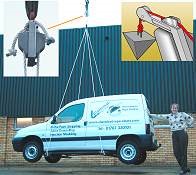
The company carried out strength tests by welding two Clamcleat® CL220VB uncoated cleats to plates which were then bolted to a lifting eye and used to lift a van weighing 1.25 tons. These tests showed that only the ends of the cleats need be welded and that the rope will break well in advance of any sign of a weld failure.
For ropes up to 12mm (1/2”) the CL219VB Racing Vertical cleat is recommended and for thicker ropes up to 16mm (5/8”) diameter, the CL220VB Racing Major should be used.
Full product and technical information on these and all other Clamcleat® products can be found at www.clamcleat.com
All aluminium cleats can be supplied to the marine trade with an uncoated finish by adding the suffix VB to the standard product number, for example CL219VB is the uncoated version of the standard CL219 cleat
Further technical information is available from Dale Emery, Clamcleats Limited, Watchmead, Welwyn Garden City, Herts AL71 AP, telephone: 01707-330101, fax: 01707-321269 and e-mail:
[email protected].
https://www.clamcleat.com/uploads/zip_files/Weldable_cleats.zip